How Does Car Recycling Work After Your Vehicle Is Removed in Melbourne?
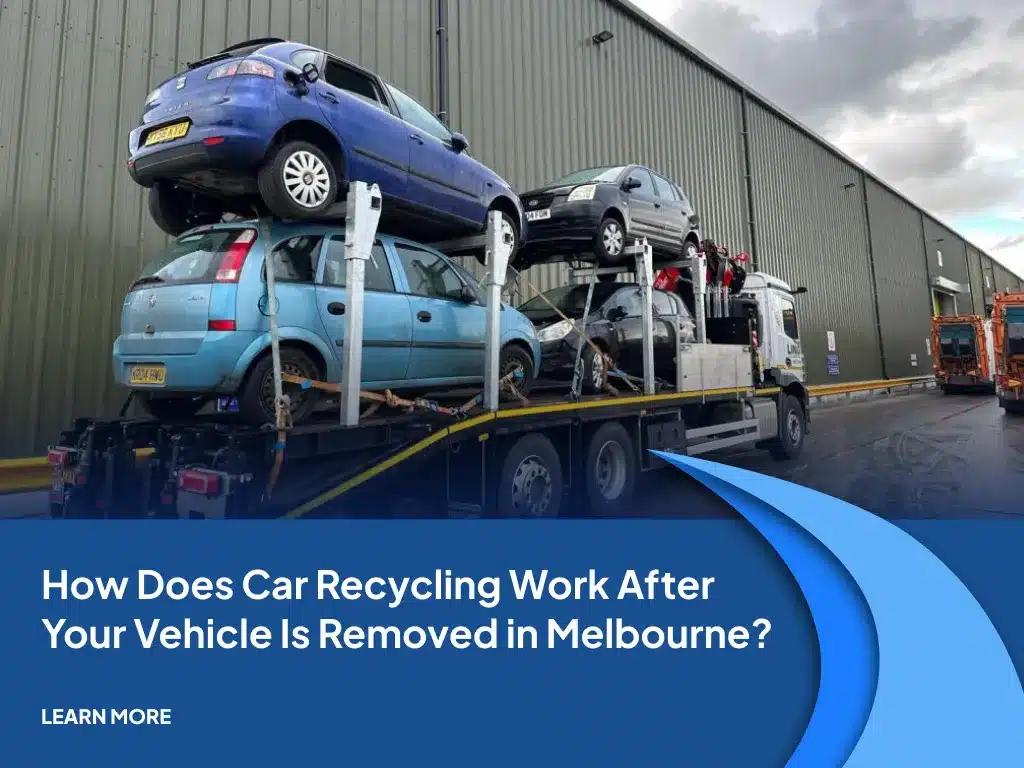
When a tow truck takes your old car away, it doesn’t just sit in a yard. Most of it gets a second life. Car recycling recovers the parts that still work, drains the fluids that could harm the environment and turns the metal shell into raw material for new steel. Here’s how car recycling works in Melbourne, step by step, once your vehicle has been removed.
Step 1: Collection and Paperwork
It starts in your driveway. The car is checked against the details you gave, you’re paid, and it’s loaded onto the tow truck. Before it leaves, sort out the paperwork. If the car is being wrecked, VicRoads asks you to remove the number plates and cancel the registration (VicRoads). Then the car goes to a licensed recycling facility (Tagg).
Not sure what to do with your plates? Read what happens to your number plates after selling a car in Victoria.
Step 2: Depollution, or Making the Car Safe
Before anything is taken apart, the car is made safe. That means removing:
- Fuel, engine oil, coolant, and brake and transmission fluid.
- The battery.
- The air-conditioning gas, which is recovered with specialist equipment rather than released into the air.
- Airbags and seatbelt pretensioners, which contain small explosive charges.
- The tyres.
Much of this is recycled too. Used oil can be re-refined, lead-acid batteries are broken down for their lead and plastic, and old tyres are processed into crumb rubber and other products.
Step 3: Recovering Parts That Can Be Reused
Next, anything with a second life is removed. Engines, gearboxes, alternators, starter motors, doors, panels, lights, wheels and mirrors can be tested and sold as second-hand parts, often for a fraction of the price of new ones. That’s why a car that doesn’t run can still be worth money.
Why the catalytic converter matters
A catalytic converter contains small amounts of precious metals, such as platinum, palladium and rhodium, which specialist refiners recover. It’s one reason buyers value a complete car more than one with parts missing.
Step 4: Shredding and Sorting the Metal
Once the useful parts are gone, the remaining shell is flattened and fed into a shredder, which breaks it into small pieces. Powerful magnets pull out the steel and iron. Eddy current separators and air flows then sort out aluminium, copper and other non-ferrous metals (Tagg).
Step 5: Turning Old Cars Into New Materials
The sorted metal goes to steelworks and smelters, where it’s melted down and made into new products. Recycling metal this way uses far less energy than producing it from raw ore. Glass, plastics and rubber can be reprocessed too, although some mixed material, known as shredder residue, still ends up in landfill.
How Much of a Car Can Be Recycled?
Most of a car’s weight is metal, so most of a typical car can be recovered. Industry sources commonly estimate that around 80–90% of a vehicle’s weight can be recycled (Tagg).
What About Hybrid and Electric Car Batteries?
The high-voltage batteries in hybrids and EVs are removed by trained technicians and sent to specialist battery recyclers. If you’re selling a hybrid or EV, mention it when you book so we can plan the pickup.
If your EV battery has failed, read EV battery replacement cost too high? Sell your car for cash.
How to Prepare Your Car for Recycling
- Remove your belongings. Check the glovebox, the boot, the door pockets and under the seats.
- Take off the number plates and cancel the rego in myVicRoads if the car is being wrecked.
- Remove your Linkt or EastLink tag.
- Don’t strip parts off the car yourself. A complete car is usually worth more.
- Have your photo ID and proof of ownership ready. See what documents you need to sell a car in Victoria.
Does Recycling Affect How Much You Get Paid?
Yes. The offer for an end-of-life car reflects what can be recovered from it: reusable parts, the catalytic converter, and the weight of metal at current scrap prices. That’s why a complete car with in-demand parts gets a better offer than a stripped shell. Find out how much cash you can get for scrapping your car.
Recycle Your Old Car the Easy Way
City Cash 4 Cars collects old, damaged and unwanted cars across Melbourne for free, pays you on the spot and sends them for responsible recycling. Book a free scrap car removal or call +61 457 063 569.
Selling a car that still runs? Get a quote for cash for cars in Melbourne.
Frequently Ask Questions (FAQs)
What happens to my car after it's removed?
The fluids, battery and other hazardous parts are removed. Working parts are recovered for resale, and the shell is shredded so its steel, aluminium and other metals can be recycled.
Is car recycling free in Melbourne?
With us it is. We tow your car away for free and pay you for it, even if it’s damaged or doesn’t run.
How much of a car can be recycled?
Industry sources commonly estimate around 80–90% of a vehicle’s weight. Most of that is steel and other metals.
Do I need to remove the number plates before my car is recycled?
Yes. If the car is being wrecked, VicRoads asks you to remove the plates and cancel the registration before you dispose of it.
Can a car be recycled without papers?
We need to see proof that you own the car before we buy it. If you’ve lost your papers, call us and we’ll explain your options.
We are a Melbourne based vehicle removal company helping individuals and businesses remove unwanted vehicles quickly and responsibly. We handle pickup, paperwork, and removal with a simple, transparent process.